
You’re moving through the exam at a good pace. You read a question, spot a statement you know is true, select it, and move on.
That’s the exact moment the test got you. The question wasn’t asking for the true statement — it was asking for the opposite, and your eyes slid past the one word that flipped it.
If you’ve ever left the ILTS thinking “I knew that material, so why did I miss points?” — this question type is one of the quietest reasons why. Let me show you how it works and the three moves that shut it down.
Why these questions catch prepared people
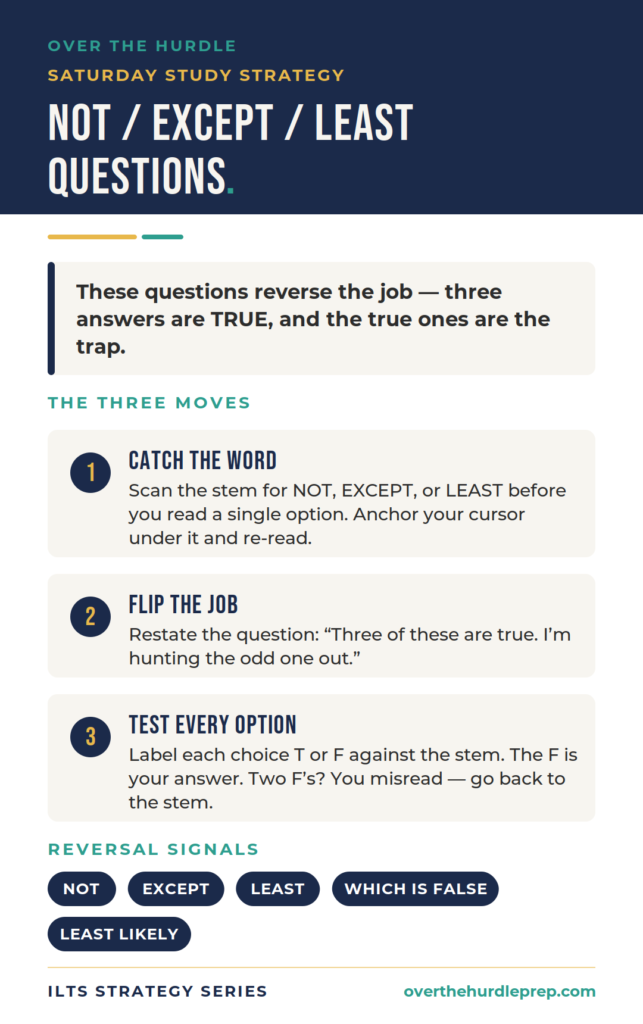
On a normal multiple-choice question, three answers are wrong and one is right. NOT, EXCEPT, and LEAST questions reverse that — three answers are true, and the true ones are the trap.
Think about what your brain has been doing for the past hour of the exam. Question after question, you’ve trained yourself on one job: scan the options, find the correct one, select it. Then a stem like “All of the following are effective strategies EXCEPT” quietly changes the job — and if you’re reading fast because you’re tired or watching the clock, your brain does what it’s been doing all day. It finds a true statement and picks it.
You didn’t miss that question because you didn’t know the material. You answered a different question than the one on the screen.
Here’s the frustrating part: your score report will never show you this happened. ILTS score reports don’t list individual questions — all you see is a lower subarea score, and a lower subarea score looks like a content gap. So you go study more content, when the real leak was one skipped word.
Move 1: Catch the word
Before your eyes touch the answer choices, your only job is the stem. Scan for NOT, EXCEPT, and LEAST — plus their cousins: “which of the following is false,” “which would be inappropriate,” “least likely.”
When you find one, put your cursor directly under that word and read the stem one more time, slowly and on purpose. That physical anchor is the whole trick. You can’t out-focus fatigue at hour three of an exam, but you can build a habit that doesn’t depend on focus.
Move 2: Flip the job
Before you read a single option, restate the question in its flipped form. “All of the following are effective EXCEPT” becomes: three of these are good — I’m hunting for the bad one. “Which is LEAST likely” becomes: rank them, take the bottom.
This takes seconds, and it changes how you read every option. Now a true statement doesn’t pull you in, because you’ve already told yourself the true ones are decoys.
Move 3: Test every option — T, T, T, F
Go down the choices one at a time and label each one true or false against the stem. Not vibes — labels. A is true, mark it T. B, T. C, T. D, false. That’s your answer.
This gives you a built-in error check, too. If you end up with two F’s, you misread something — go back to the stem. If you end up with four T’s, you’re probably on a LEAST question, and your job is ranking, not true-or-false.
This is a reading skill, not a knowledge problem
If you’ve failed the ILTS before and you’re searching for what to do differently, hear this clearly: missing NOT and EXCEPT questions doesn’t mean you need another study guide. Every fact in that question might be something you know cold. This exam isn’t just measuring what you know — it’s measuring whether you read the way the test is written. Those are two different skills, and the second one takes weeks to build, not months.
But it only builds with practice — watching someone explain it isn’t the same as running the moves yourself.
That’s what my Wednesday emails are for. Every week I take the strategy from that week’s video and walk one full worked example, step by step, then give you a question to try on your own. It’s free, it’s one email a week, and it’s the closest thing to sitting next to me while I work a question. Join the list here.



Leave a Reply