
If you’re prepping for the redesigned Elementary Education exam, there’s one scoring detail that catches almost everyone off guard: hitting the minimum on all six subtests does not automatically mean you passed the exam. The scoring model works differently than that — and if you don’t know how, you can do everything “right” and still come up short.
Pearson has released more detail on how the redesigned exam is scored, so let me walk you through what it actually takes to pass — and how to turn your score report into a plan instead of a verdict.
The misconception that costs people a retake
The most common thing I hear right now is some version of this: “If I get the minimum passing score on all six subtests, I pass.” It sounds completely reasonable. It’s also not how this scoring model works.
You can clear the minimum on every subtest and still not have the overall score the exam requires. That gap — between “I passed each part” and “I passed the exam” — is where a lot of capable people lose a retake fee they didn’t need to spend.
The three things that all have to be true to pass
When you read Pearson’s requirements carefully, passing isn’t one condition. It’s three, and all of them have to be true at the same time.
One: you have to meet the minimum on each subtest. Every subtest has its own qualifying score you need to reach. Miss it on one, and that subtest isn’t done yet — no matter how well you did on the others.
Two: your subtest results get banked. Once a subtest meets its qualifying requirement, that result can count toward your exam instead of resetting every time you sit down. That’s genuinely good news, and we’ll come back to why it matters for your strategy.
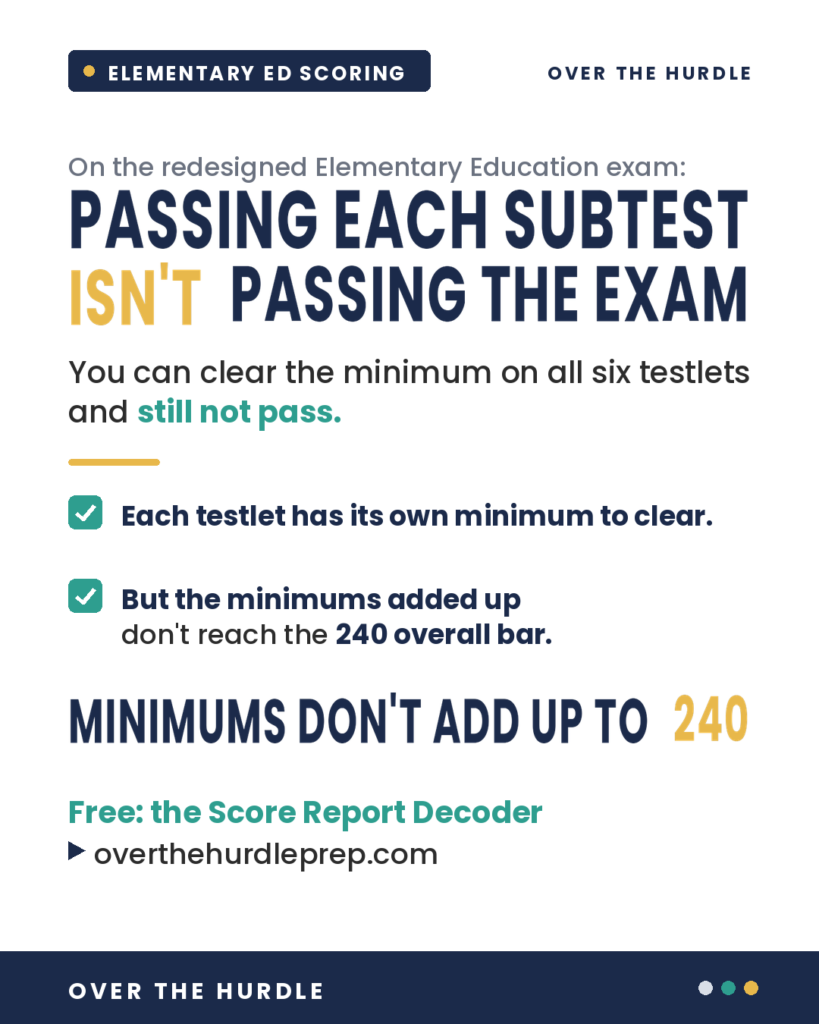
Three: you have to reach the 240 overall requirement. This is the one people miss. Meeting the minimum on all six subtests does not necessarily add up to the overall score you need. The minimums and the 240 are two different bars — and clearing the first set doesn’t guarantee you clear the second.
What “banked” actually means
Let me put “banked” in plain terms, because the word gets thrown around without much explanation.
Once a subtest meets the qualifying requirement, that score is locked in and can count toward your exam — you don’t have to start over from scratch every attempt. So you’re building the exam up over time, subtest by subtest, instead of re-earning everything on every test date.
Here’s the catch, and it’s the whole point: banking your minimums doesn’t mean you’ve banked a passing exam. You can have several subtests safely banked and still be sitting below that 240 overall requirement.
The real question isn’t “what do I need to pass?”
Once you understand banking and the 240 bar, your score report stops being a verdict and becomes a planning tool. And the question changes.
Most people look at a report and ask, “What do I need to do to pass?” The more useful question is, “Where do I need points?” Those sound similar, but they lead to completely different study plans.
Because your subtests are banked, you’re not starting over — you’re looking for the specific places you can gain the points that get you to 240. That might mean the subtest you haven’t passed yet. It might also mean going back to one you technically “passed” but where you’re sitting close to the floor and have the most room to grow.
What to do with your own score report
If you’ve got a score report in hand, pull it out and look for three things. This is the same read I do at the start of any plan.
First, which subtests have already met the qualifying requirement — the ones that are banked and off your plate.
Second, your strongest and weakest results, so you know where the room actually is. Your best subtest is usually your ceiling, not your opportunity; the ones near the floor are where the cheap points tend to live.
Third, how far your overall score is from the 240 requirement — the real gap you’re trying to close, not just “did I pass each part.”
One important note: your score report shows you subtest and subarea results, not the individual questions you got wrong. So this is about reading your scores strategically — using the numbers you do get to see to decide where your next attempt should focus.
Not sure what your score report is actually telling you?
If you’re looking at a report and you’re not sure what it’s saying — which subtests are banked, where your points are, how far you are from 240 — that’s exactly what I built the Score Report Decoder for. It’s a simple, free walkthrough that helps you break down your report before you decide what to study next.
Get the free Score Report Decoder →
Your goal isn’t just to keep retaking tests and hoping the number moves. It’s to understand exactly what your scores are telling you, and build your next attempt around that.



Leave a Reply