
“I’ve failed the ILTS twice, I’ve used practice tests and Quizlet, and I don’t know what to study anymore.”
If that’s you, here’s the short version before you read another word: the problem usually isn’t how much you’re studying, and it often isn’t even the quality of the resource you bought. It’s that the resource doesn’t match the specific reason you’re losing points. There are four different reasons people fail the ILTS, and each one needs a completely different fix.
So before you buy one more study guide, the real question isn’t “what should I use to study?” It’s “what is actually costing me points — and which resource fixes that?”
A good resource can still be the wrong resource
Here’s the belief I want to change: that if you just find a better program, a bigger question bank, or one more tutor, the score will finally move.
I’ve watched capable people buy resource after resource and stay stuck at the same score. Not because the resources were bad — a lot of them were genuinely good. They were just built for a different problem than the one that person actually had.
Practice tests and Quizlet are tools. They are not a study plan. A flashcard app is excellent at one job and useless at another, and if your problem is the “another,” it doesn’t matter how good it is.
First, figure out which gap is actually yours
When you miss a question, the miss has a cause. And there are really only four.
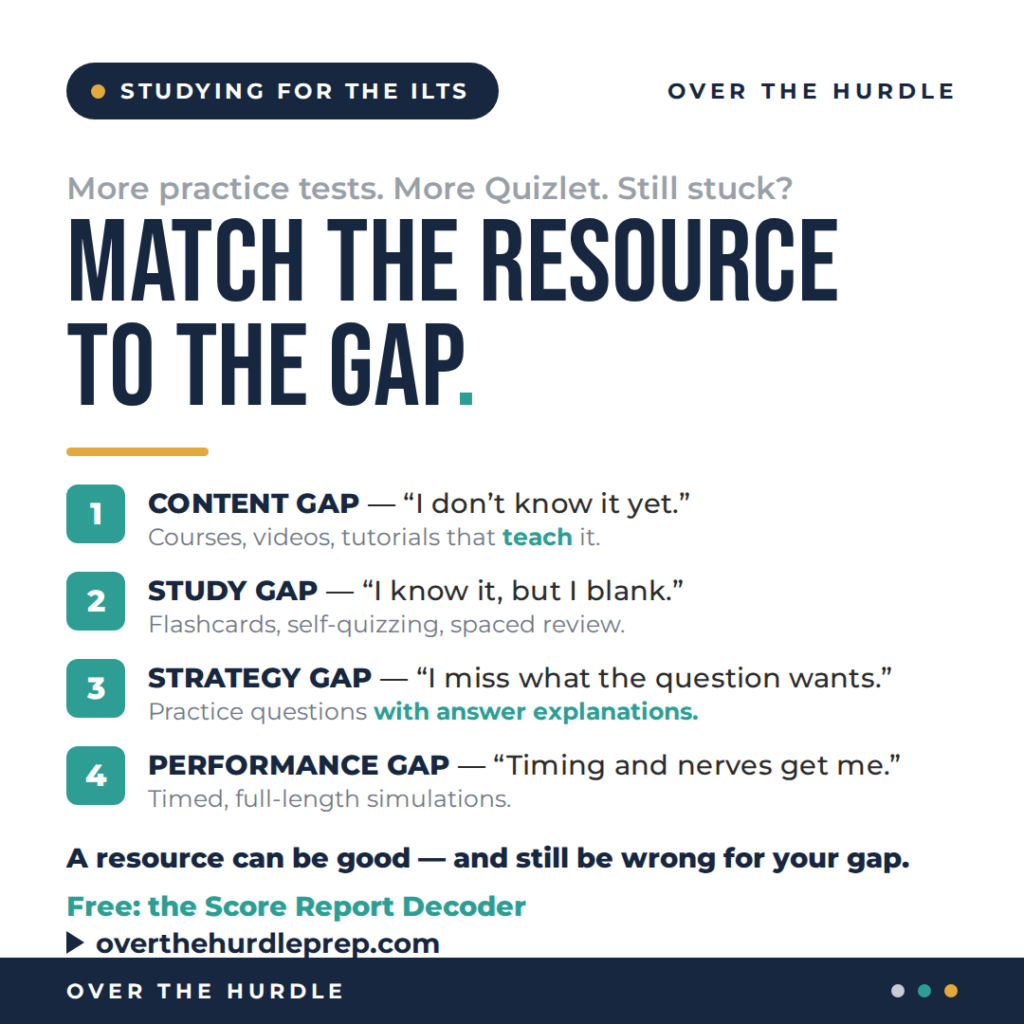
A content gap means you genuinely don’t know or understand the material yet. A study gap means you’ve reviewed it, but you can’t retain or recall it when it counts. A strategy gap means you know the content, but you keep misreading what the question is asking or getting pulled toward the wrong option. A performance gap means timing, anxiety, fatigue, or second-guessing is quietly eating your points.
Here’s the part almost nobody does: after a miss, they check the right answer, nod, and move on. But the right answer isn’t the lesson. Why you picked the wrong one is. That “why” is your gap.
Look for the pattern, not the one wrong answer
One missed question tells you almost nothing. The pattern across several tells you everything.
Next time you review, don’t just mark questions right or wrong. For each miss, ask what the question actually required you to do. Was it asking you to recall a fact, interpret a scenario, apply a concept, analyze a situation, or evaluate the best option? Those are different skills, and you can be strong at one and shaky at another.
Then get specific about the miss itself. Did you misunderstand what was being asked? Did you know the content but freeze on how to apply it? Were you stuck between two answers that both looked reasonable? Did you overlook one important word — an “except,” a “not,” a “first,” a “most appropriate”? Or did you have the right answer and talk yourself out of it?
Do that across five or six missed questions and a pattern shows up. Maybe you keep landing between two reasonable options — that points to a strategy gap. Maybe you keep changing correct answers — that’s performance. The pattern, not any single question, is what tells you which resource you actually need.
Match the resource to the gap
Once you know your gap, the right resource becomes obvious. Here’s the whole thing at a glance:
| Your gap | What it sounds like | The resource that actually fixes it |
|---|---|---|
| Content | “I didn’t really know this.” | Courses, targeted videos, tutorials that teach and explain the concept — with examples to apply it. |
| Study | “I knew it last week and blanked.” | Retrieval practice: flashcards, self-quizzing, spaced repetition. Anything that makes you produce the answer, not reread it. |
| Strategy | “I knew it, but I picked the wrong one.” | Practice questions with detailed answer explanations. Study question types and distractor patterns — practice the decision, not just the fact. |
| Performance | “I ran out of time / talked myself out of it.” | Timed sets and full-length simulations. Build a pacing plan and a rule for questions you’re unsure about. |
Same effort, four different fixes. This is why “just study more” so often fails: more of the wrong resource is still the wrong resource.
Read your score report — but don’t overread it
Your ILTS score report is the best clue you have about your gap, as long as you know what it can and can’t tell you.
It shows you your subarea scaled scores, which point you toward where you’re losing ground — the domains that are dragging you down. What it does not do is show you which individual questions you missed. There’s no item-by-item breakdown, so anyone promising to review your “wrong answers” is selling you something the test doesn’t provide.
Two more things worth knowing, because they change how you study. The ILTS is scored on a 100–300 scale, and 240 is passing — but only your overall score determines pass or fail. Your subarea scores are diagnostic, not individual hurdles. And there’s no penalty for a wrong answer, so a blank is never the right move.
Put those together and a score report stops being a verdict and starts being data. A low subarea plus a pattern in the questions you struggle with usually points straight at your gap.
It also tells you where your time is worth the most. If one domain is well below the rest, that’s where an hour of the right kind of study moves your overall score the furthest — and where the wrong kind of study is most tempting and least useful. A strong subarea rarely needs more of your attention just because it feels good to practice what you’re already good at.
Before you spend another dollar, ask these five questions
Run any resource through this before you buy it:
Which specific gap will this help me close? Does it teach, help me retain, build test-taking strategy, or strengthen performance — and is that the thing I’m missing? Does it match the kinds of questions I actually struggle with? Does it explain the reasoning behind the answers, not just mark them right or wrong? And will it let me see whether my performance is actually improving?
If a resource can’t answer those, it’s not the one — no matter how good the reviews are.
Stop collecting resources. Start diagnosing.
You don’t need to study everything, and you don’t need to buy every program someone recommends. You need to find the pattern in the questions you’re missing, name the gap behind it, and choose the one resource that closes that gap.
The fastest place to start is your own score report. I made a free Score Report Decoder that walks you through turning those subarea scores into a plan instead of a guess — grab it here. It costs nothing, and it’s built to help you find your gap before you spend another cent.
If you’d rather talk it through, I also offer a free 20-minute strategy call and a monthly workshop on how the ILTS thinks — here’s how to work with me.



Leave a Reply