
If you keep failing the ILTS even though you know the material, the problem probably isn’t how much you know. It’s something nobody teaches: how the test wants you to use what you know.
I call that a Strategy Gap — the space between knowing the content and knowing how the exam asks you to apply it. You can have the content maxed all the way out and still lose points on the second skill. And more studying doesn’t close it, because studying was never the thing that was broken.
Knowing the content and passing the test are two different skills
Most people walk in believing one thing: if I know the material, I’ll pass. And the flip side — if I failed, I must not have known it well enough. It’s the story we’re all taught. In school, it was usually true.
But this isn’t a school test. It’s checking whether you can do a specific thing with the material, under its rules, in the way it’s already decided is “best.” That’s a different skill than knowing the content — and it’s the one quietly costing capable people their score.
The clue: you keep getting it down to two
Here’s the tell. You read a question, and you knock out two of the four answers fast — those were obviously wrong. Now you’re down to two. You read them both again. And they both look right.
You pick one. Maybe you go with your gut, maybe the longer one, maybe the one that “feels” like a teacher answer. Weeks later the letter says you didn’t pass, and you can’t point to a single thing you didn’t know.
That two-answer moment, happening over and over, is not bad luck. It’s the Strategy Gap showing up — and notice, it happens after your content knowledge already did its job. Knowing more wouldn’t have changed it. You’d already used everything you knew.
Why the wrong answers are so convincing (they’re called distractors)
On a school test, the wrong answers are usually obvious throwaways. On the ILTS, they’re not. They’re built.
Someone wrote them to look right — to be the answer a smart, prepared person reaches for when she’s moving fast or grabbing the most familiar-sounding option. They have a name: distractors. And they’re doing a job on you.
That’s why “just know the content better” doesn’t protect you here. A good distractor is designed to catch the person who does know the content. Knowing more doesn’t make you immune — recognizing the pattern does. And that’s a strategy skill, not a knowledge one.
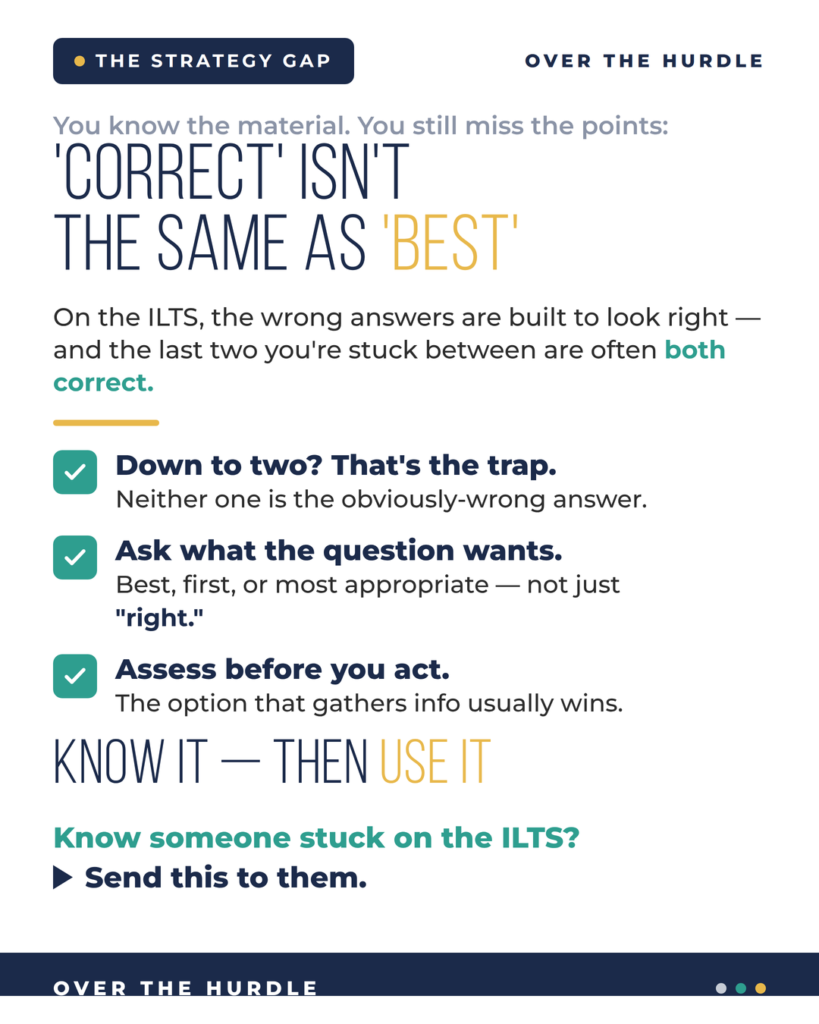
“But both answers are technically right”
Here’s the part that makes the two-answer trap click. A lot of the time, when you’re stuck between two, it’s not because you don’t know which is correct. It’s because both of them are correct.
They’re both true. Both defensible. If the question were “which of these is right,” you could bubble either one. But that’s not the question. The ILTS asks for the best answer — the most appropriate one, or the one you’d do first.
“Correct” and “best” are two different questions. If you walk in answering which one is correct, you’ll keep landing in that trap no matter how much content you know. That’s the Strategy Gap in one sentence: the test asked for the best answer, and you gave it a correct one.
The test has rules — here’s one: assess before you act
If the exam has a definition of “best,” the fair question is: best according to what? It’s not random. The ILTS has decision-making logic baked in, and once you can see it, those two-answer moments stop being coin flips.
Here’s one piece of that logic, so you can feel what I mean. When a question drops you into a scenario and asks what you should do, you’ll usually see at least one answer that jumps straight to acting, and at least one that gathers information first — observing, checking, finding out more. When both are reasonable, this test overwhelmingly rewards the one that assesses before it acts.
Notice what that is: not content, a rule about how the test thinks. It holds whether you’re testing in early childhood, special ed, secondary, or a content area — and it’s exactly the kind of thing that never shows up in a content review, because it isn’t content.
Do you have a Strategy Gap? A quick check
Don’t overthink these. Just notice how many make you go that’s me.
You regularly get it down to two answers, pick one, and never feel sure you picked right. You finish with time to spare and walk out feeling okay — then the score says otherwise. When you go back over a domain your report flagged low, you actually know it; it’s not new to you.
You’ve come up short by a small margin, close but not over. You catch yourself thinking “wait, both of these are right” more than once a section. And more studying hasn’t moved your score much, even though you put in the real hours.
If three or more of those sound like you, more content isn’t your problem — a Strategy Gap is. And that’s genuinely good news: a Strategy Gap is fixable, and it’s fixable a lot faster than re-learning everything you already know.
So what do you actually do about it?
Not this: walk back in guessing, throwing more hours at a problem you haven’t named. If the thing costing you points is how you read the questions, more content is motion without progress.
Start by naming it. Think back to your last attempt — not the score, the experience of it: the pace, the calm or the panic, the questions where two answers both looked right. That’s the first real clue that strategy, not content, is what’s costing you.
And if you want a faster way to figure out what’s actually keeping you from a passing score, the easiest first step is free: a 20-minute strategy call. Bring your questions about your prep, your strategy, or your score report — there’s nothing to prepare in advance, and we’ll spend the 20 minutes on whatever matters most to you right now. No charge, no pitch — grab a time here.
Two more ways to work with me
- Monthly Strategy Workshop — a live session on how the ILTS thinks and how to beat it.
- 1:1 Strategy Coaching — send me your score report(s) and I map exactly where the test is beating you, then build a targeted plan for your next attempt.



Leave a Reply