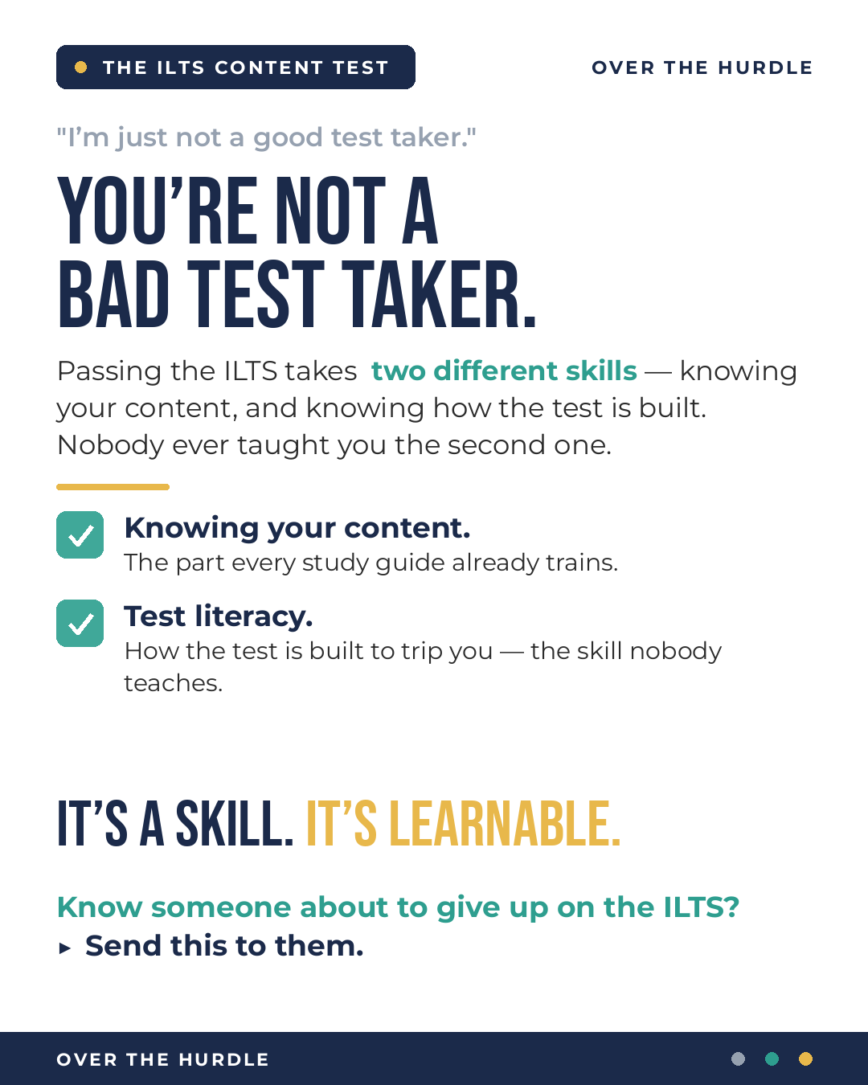
If you keep failing the ILTS even though you know your material, I want to tell you something before you sign up for another retake: you are probably not a bad test taker. You were just never taught how this test actually works.
I don’t say that to make you feel better. I say it because I’ve watched it up close for years, and it’s true.
First, a little about why I care so much about this
I taught for ten years on the South Side of Chicago. I loved it — before anything went sideways, we had a real team, we were locked in on our methods, and the thing that mattered most to us was watching our kids actually grow.
I stayed through the shutdown, the online year, and the return to the building. What eventually moved me out of the classroom wasn’t the students. It was watching who was allowed to stand in front of them — and who wasn’t.
The thing that broke my heart about the teacher shortage
We’re in a real teacher shortage in Illinois. You already know that. What you might not see from the outside is how it plays out.
When capable, licensed teachers leave, buildings still need a body in every room. So classrooms get filled by whoever’s available — and some of those people are not teaching anyone anything. Meanwhile, some of the most dedicated, rigorous people I know are being kept out of full-time teaching roles. Kept out by one hurdle: the Illinois teacher licensure exam, the content test.
That’s backwards. And it’s the reason I started Over the Hurdle.
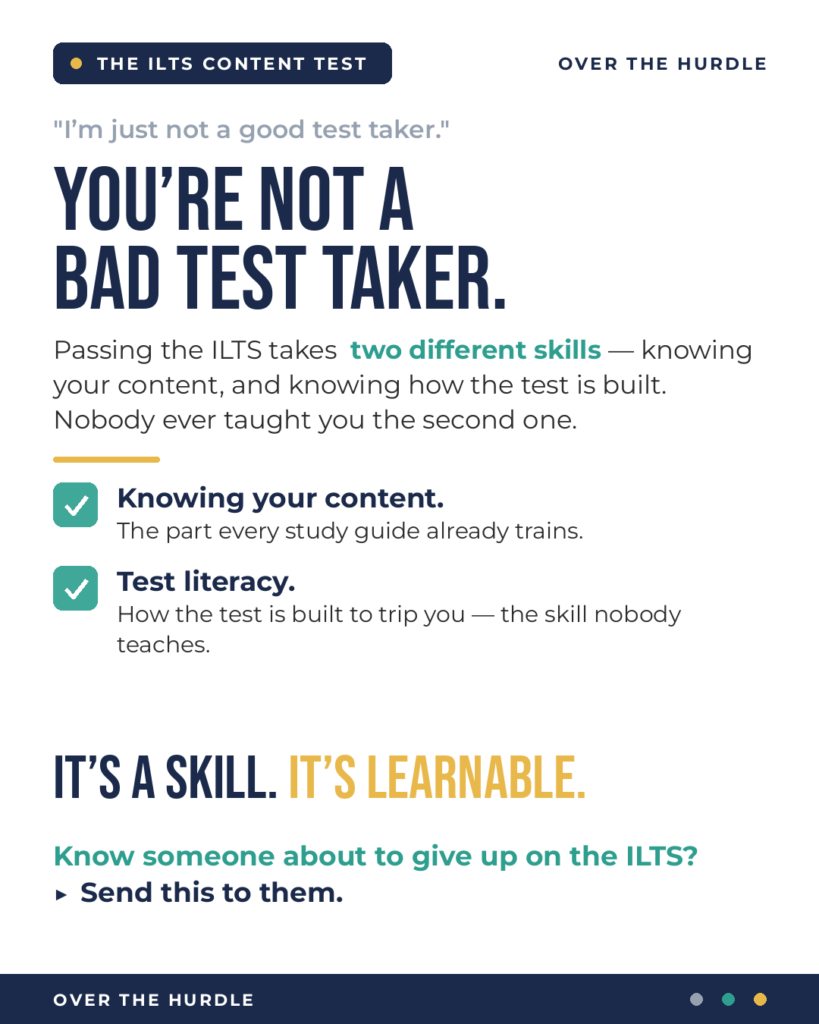
Passing the ILTS takes two skills — and no one teaches the second one
Here’s the piece almost nobody explains. Passing the ILTS content test takes two different skills, not one.
The first is knowing your content. That part you get. That’s the part every study guide on the market is built around.
The second is test literacy — knowing how the test itself is built, how the questions are written, and how a wrong answer gets dressed up to look right. That skill is the difference between people who pass and people who keep coming up just short. And it’s the one nobody ever taught you.
So why do I keep failing the ILTS when I know the material?
Because knowing the content and answering the test’s version of a question are two different jobs.
When I actually sit with someone who’s failed more than once, here’s what I usually find: they know their stuff. What’s costing them isn’t knowledge — it’s test-taking. The people who write these questions are teachers and researchers. They know exactly which wrong answer will look right to a smart, prepared person moving quickly through a section. That’s not a flaw in you. That’s the test doing its job on a skill you were never handed.
Which is why “just study harder” so often doesn’t move the score. If studying were the missing piece, more of it would help. When it doesn’t, that’s your clue the gap is somewhere else.
“I’m just not a good test taker” — who told you that?
I hear this all the time, and I always want to ask: who told you that, and how long ago?
Usually it traces back to something that happened in second or third grade, around the time standardized tests first showed up. Somewhere in there you picked up a story about yourself, and you’ve been carrying it ever since. But you passed your driver’s test, didn’t you? “Bad test taker” isn’t a fixed trait you were born with. It’s a skill gap — and skills can be closed.
A failing score measures one day. Not you.
This is the part I most want you to sit with.
A failing ILTS score is not a verdict on your intelligence, and it’s not a verdict on the teacher you’d be. It measures one thing: how you performed on one test, on one day.
Think about your ACT or SAT scores. By your senior year of college, nobody was asking for those numbers anymore, because they never really measured you. The content test is the same. It feels enormous right now because your license or your job is riding on it — but it is a bureaucratic hurdle, not a measure of your worth as an educator.
So what do you actually do about it?
Not this: walk back in and take the same exam the same way, hoping it lands differently. That’s how a retake turns into another retake.
Start by naming what’s actually happening. Think back to your last attempt — not the score, the experience of it. The pace. The questions where two answers both looked right. The moment you second-guessed yourself. That’s the first real clue that test literacy, not more content, is what’s standing between you and a passing score.
And if you want help figuring out exactly what’s costing you, the easiest first step is free: a 20-minute strategy call. Bring your questions about your prep, your strategy, or your score report — there’s nothing to prepare in advance, and we’ll spend the 20 minutes on whatever matters most to you right now. No charge, no pitch — grab a time here.
You are not a bad test taker. You were never taught the test. Let’s fix the part that’s actually fixable — and get you over this hurdle.
Two more ways to work with me
- Monthly Strategy Workshop — a live session on how the ILTS thinks and how to beat it.
- 1:1 Strategy Coaching — send me your score report(s) and I map exactly where the test is beating you, then build a targeted plan for your next attempt.
Leave a Reply