
If you keep hitting ILTS questions that ask “what should the teacher do first?” or “what’s the next step?” — and you walk out of the test unsure even on the ones you should have known — this is for you. These first-step and next-step questions are one of the most common places smart, experienced candidates quietly lose points, and it has almost nothing to do with what you know.
Let me show you what’s actually happening, and the four moves I use to answer them.
Two answers can both look right — that’s the trap
On a lot of these questions, two of the four options are things a good teacher would genuinely do. Not one strong answer and three obvious throwaways — two you could defend out loud, with a straight face.
So you pick one, move on, and never find out which one the test wanted. The ILTS gives you a score at the end, not the questions — so this can cost you over and over without you ever seeing it happen.
That’s not a knowledge gap. It’s a question type doing something you weren’t told about.
“Best answer” and “first step” are not the same question
You’ve practiced “best answer” and “most appropriate” questions. Four options, one is strongest, the other three are weaker or wrong. Your job is to rank them by quality and grab the top one. You’re good at those.
“First step” and “next step” questions look identical — but they ask something different. Instead of which option is strongest, they ask which one comes first. The job switched from ranking to sequencing.
And “right, but not first” is scored exactly the same as wrong.
Why all four answers look right
Teaching is contextual, and the ILTS knows it. So on a well-written scenario question, the wrong answers usually aren’t bad teaching — they’re real, reasonable moves placed in the wrong order.
That’s why your normal filter fails you here. If you evaluate each option by asking “is this good practice?”, most of them pass. You can’t tell them apart that way, so you end up grabbing whichever good move you’d personally reach for — and that’s the trap dressed up as an instinct.
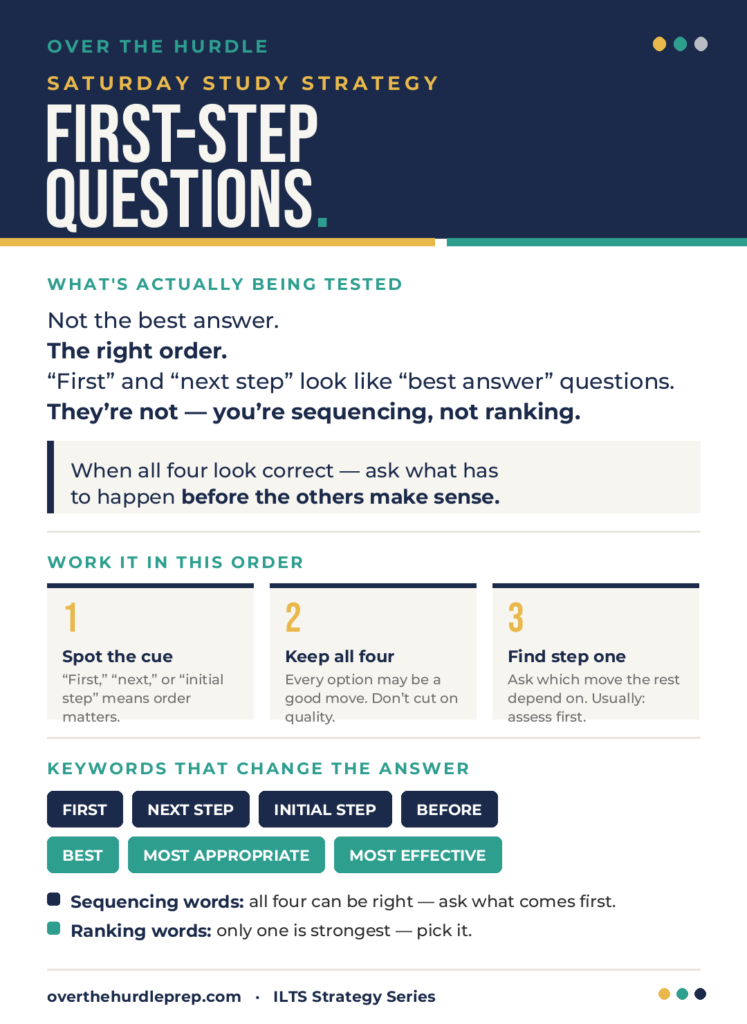
Four moves for ILTS scenario questions
Here’s the sequence I use the second I spot one of these. It takes seconds once it’s a habit.
1. Catch the word. The instant you see “first,” “next,” or “initial step,” mark it. That word tells you the game changed — you’re ordering now, not picking the best. Most people miss the point because they never registered the word.
2. Expect all four to look reasonable. Don’t waste time asking “is this good teaching?” — assume most of them will pass. That’s normal on these. It’s not progress.
3. Ask what has to happen before anything else works. This is the move that scores. When a student is struggling, you can’t choose the right response until you know what you’re dealing with — so the first step is almost always the one where you gather information. Observe, look at the work, check the data, talk to the student.
4. On a “next step,” read what already happened. “Next” means something in the scenario already took place. The right answer continues that sequence — it doesn’t repeat a step the teacher already took, and it doesn’t skip to the end. Read for where you are in the story.
The pattern the ILTS rewards: find out before you act
If you remember one thing, remember this: on the ILTS, assess before you act. Find out before you fix.
Picture a secondary science question where a student who usually does fine suddenly bombs a unit test. The options are all things you might do — reteach the unit, offer a retake, move his seat, or talk with him to find out what changed. Three of those are actions. One is finding out. On a “first step” question, the test wants the finding-out — because reteaching the wrong thing is just wasted time, and the exam is built to reward the teacher who diagnoses before she intervenes.
Once you see that pattern, these questions stop feeling like coin flips. You stop guessing between two good answers and start putting them in order — and the order has a rule.
Not sure if this is costing you points?
This is exactly the kind of habit that’s hard to catch on your own, because the score report never shows you which questions did it. That’s what I built the Strategy Gap Screener for — 20 questions, no studying required, that surface the test-taking patterns working against you.
Take the free Strategy Gap Screener →
It’s free, it takes about ten minutes, and it’ll tell you whether sequencing questions like these are a real leak in your score — or whether your points are going somewhere else entirely.



Leave a Reply