
You knew that question. That’s the part that doesn’t make sense.
You read it, you felt sure, you clicked, you moved on. No hesitation, no alarm bell. And then the score came back and you failed — and you couldn’t tell anyone which questions you got wrong, because the ILTS score report doesn’t show you that. It only reports subarea scores. So you’re left with a fail and no explanation.
When that happens enough times, you start reaching for the only explanation left: I’m just bad at tests.
I want to take that apart. Because if you keep failing the ILTS on questions you understood, it’s almost never a content problem. It’s one specific word you were never taught to read.
“I’m a bad test taker” is usually about third grade, not the ILTS
Almost everyone who comes to me after failing the ILTS a second or third time says some version of the same sentence. I’m just bad at tests. Flat, like they’re reporting the weather.
And when I ask about it, they’re never actually talking about the ILTS. They’re talking about third grade. That bubble sheet, that clock, that feeling in their stomach. Twenty years of evidence, stacked up.
Here’s what I think really happened. Somewhere back there, “this format doesn’t show what I know” turned into “something is wrong with me.” Those are two completely different sentences. And the second one isn’t true.
The question that makes good teachers doubt themselves
Let me show you the kind of question I’m talking about. You’ve seen a version of it.
A second-grade student rushes through his independent work and makes careless errors. Which of the following is the MOST APPROPRIATE way for the teacher to support the student?
- A. Remind the student to slow down and check his work
- B. Reduce the amount of work assigned
- C. Conference with the student to set a goal and teach him a self-monitoring checklist
- D. Move the student to a quieter area of the room
You read A. Remind him to slow down and check his work. And something in you goes — yeah, that’s good teaching. You’ve done that this week.
Click. Next question. You never felt a thing.
Option A isn’t wrong. That’s the whole trap.
Here’s what makes this so hard. Option A is not a bad answer.
Read it again. It’s good teaching. You’d tell a colleague to do it. On a rubric, it would pass. It is a correct answer — to a question the test didn’t ask.
Because the test didn’t ask which answer is right. It said MOST APPROPRIATE. And “most appropriate” means more than one of these is right. Rank them. They built two good answers on purpose — that’s the item.
If you walk into that question hunting for the answer that’s correct, you’ll find one. Fast. And you’ll click it and never go looking for the better one, because you already found a right one. You weren’t failing because you didn’t know the content. You were answer-hunting in a question that was asking you to rank.
The move: BEST means rank, not find
So here’s the rule, and it’s the thing I want you to actually keep.
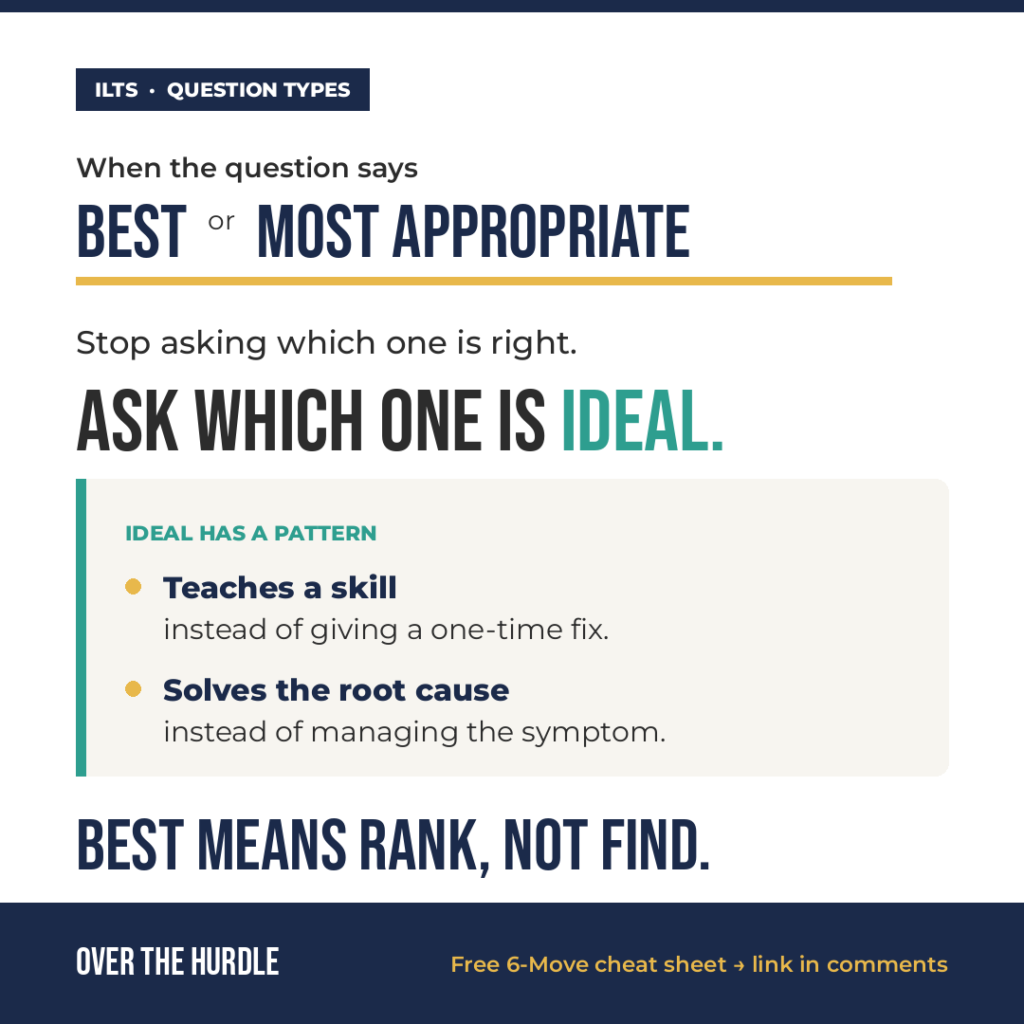
Every time you see BEST — every time you see MOST APPROPRIATE — stop asking which one is right. Ask which one is ideal.
And “ideal” has a pattern that shows up all over this exam:
- Ideal teaches a skill instead of giving a one-time fix.
- Ideal solves the root cause instead of managing the symptom.
That’s the whole tiebreaker. Two lines.
Watch it decide the question
Hold A and C side by side.
A. Remind him to slow down. What happens tomorrow? He rushes again, and you remind him again, and the day after that you remind him again. You’re managing the symptom forever. One-time fix.
C. Conference with him, set a goal, teach him a self-monitoring checklist. What happens tomorrow? He checks his own work — because you taught him how. That’s the root cause, and C is the only option that goes after it.
Same student, same question, same four options. A is acceptable. C is ideal. BEST always rewards ideal. And B and D were never really in it — they’re accommodations for a problem this student doesn’t have.
This is a blank space, not a flaw
So go back to that story you’ve been telling yourself. I’m a bad test taker.
On that question, you knew the content. You recognized good teaching. Your instinct about that second grader was correct. What you didn’t have was a rule for the word MOST. That’s the entire gap.
You can’t be bad at something nobody ever taught you. That’s not a flaw — it’s a blank space, and blank spaces get filled in. I’ve never met a bad test taker. I’ve met a lot of good teachers who were never shown how this test reads.



Leave a Reply