
You knew the content. You picked the answers that made complete sense — and walked out of that test center feeling okay about it.
Then the score came back. Did not pass. And you have no idea where it went sideways, because the ILTS never tells you which questions you missed.
If that’s where you are, you’re not losing it. Many people struggle with scenario questions because aren’t testing what you know. They’re testing whether you can think the way the test wants you to think. Yet, nobody ever taught you what that means.
Let me break it down.
What scenario questions are actually testing
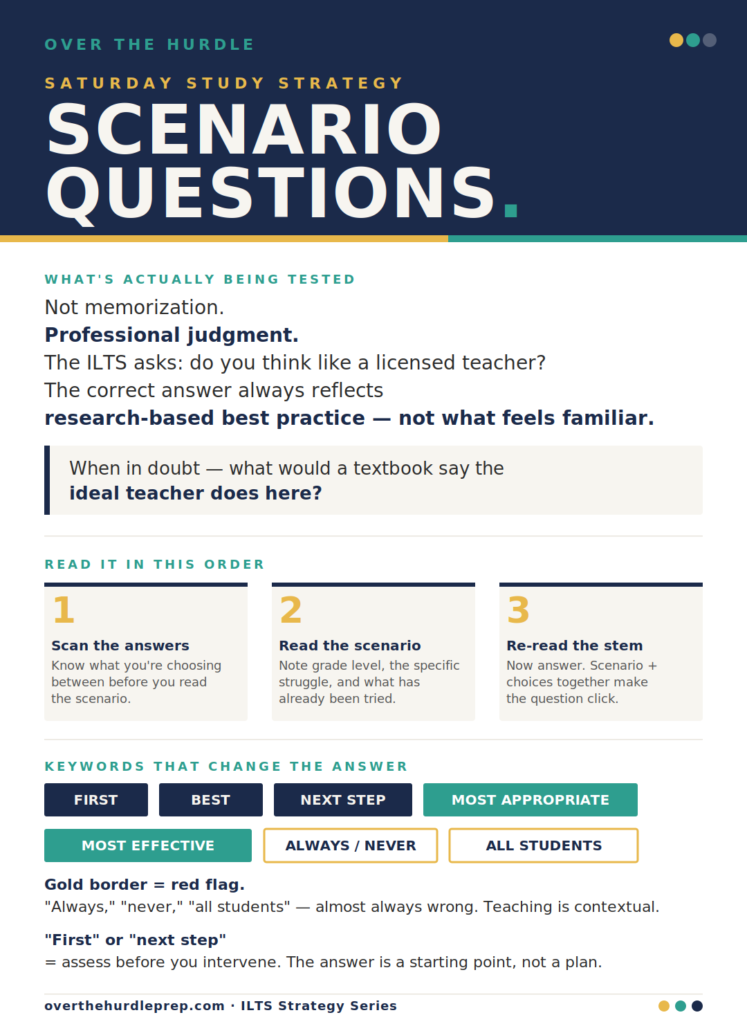
Scenario questions aren’t measuring your memory. They’re measuring your professional judgment.
The ILTS is asking one question over and over, in a hundred different outfits: do you think like a licensed teacher? Not like a substitute who’s been winging it. Not like the aide who knows the kids better than anyone. Like a teacher who’s read the research and applies it on purpose.
So the correct answer always reflects research-based best practice — not what feels familiar, not what you’d actually do on a chaotic Tuesday. When you’re stuck between two options, stop asking “what would I do?” and ask “what would a textbook say the ideal teacher does here?”
That single shift fixes more wrong answers than any amount of content review.
Read the question in this order
Most people read a scenario question top to bottom: scenario first, then the four choices. That’s backwards, and it’s costing you points.
Try this order instead:
1. Scan the answers first. Before you read a single word of the scenario, look at what you’re choosing between. Now you know what the question is really after.
2. Read the scenario. Note the grade level, the specific struggle the student is having, and — this matters — what the teacher has already tried. The test loves to bury the answer in that last detail.
3. Re-read the stem, then answer. With the choices already in your head, the scenario and the question click together. You’re not reading blind anymore. You’re reading with a filter.
It feels slower the first few times. It gets faster fast. And it stops you from falling for the answer that sounds right before you’ve even understood what’s being asked.
The keywords that quietly change the answer
The ILTS hides the whole meaning of a question in one or two words. Miss them and you’ll answer a question that was never asked.
Watch for these:
“First” or “next step.” When a question asks what you should do first, the answer is almost always to assess or diagnose before you intervene. The right answer is a starting point, not the whole plan. If an option jumps straight to a solution, it’s usually a trap.
“Best” or “most appropriate.” This is the sneaky one. With these questions, all four answers might be technically correct. You’re not picking what’s true — you’re picking what the ILTS prioritizes most. That’s a different skill entirely.
“Always,” “never,” “all students.” Treat these like a red flag. Teaching is contextual — almost nothing is true for all students all the time. Answers using extreme language are almost always wrong.
Once you start spotting these words, you can’t unsee them. They’re in nearly every scenario question on the exam.
Why this matters more than another study guide
You can know phonics cold and still come up short on the literacy scenario questions. You can be brilliant with kids and still miss the answers the test was looking for. That’s the cruel part of this test — it doesn’t reward what you already do well in a real classroom.
But there’s something worth holding onto in that: this is learnable. Scenario logic isn’t a talent some people are born with. It’s a pattern. Once you see how the test thinks, you stop guessing and start targeting.
You’ve been studying the content. The content was never really the problem.
If your score report came back with low numbers in a subarea and you’re not sure what that actually means for your next attempt, grab my free Score Report Decoder. It walks you through exactly what those scaled scores are telling you so you can target your prep instead of starting over.
And if this helped — drop a comment and tell me which keyword has tripped you up before. I read every one.



Leave a Reply