You scored a 233. Seven points short. And the first thing someone told you was to study more. I want you to ignore that advice for a second.
You don’t get a 233 because you don’t know the material. People who don’t know the material don’t land in the 230s. They land much lower. A 233 means you knew enough to get most of it right — and then something happened to the rest.
That something has a name. And it’s fixable in one sitting, no extra studying required.
You’re not losing those points to content. You’re losing them to second-guessing.
Think about your last attempt. Be honest with yourself.
How many times did you land on an answer, feel decent about it, move on — and then come back later, stare at it, and switch it? Not because you found new information. Not because you suddenly remembered the rule. Just because the original answer started to feel wrong the longer you looked at it.
That feeling is the leak. Those are the points draining out of your score one question at a time.
When you change an answer on a feeling, you send a right answer to wrong more often than you save a wrong one. That’s not a personal flaw. It’s how second-guessing works under pressure — and the testing room is built to crank that pressure as high as it goes.
The one rule for changing an answer on the 290
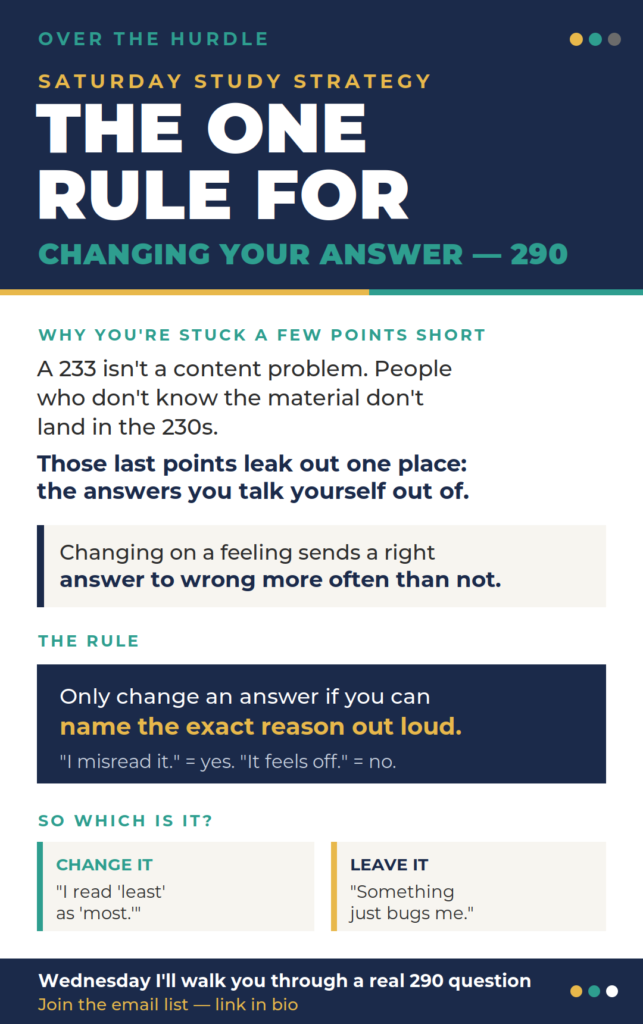
Here it is. Print out the image or write it on your hand if you have to.
You can only change an answer if you can name the exact reason out loud.
Not in your head. Out loud — or close enough that you could say it in one clear sentence if I were sitting next to you.
A real reason sounds specific. “I misread it. The question says ‘least likely,’ not ‘most likely.'” That’s a reason. You caught a concrete mistake. Change it.
A feeling sounds vague. “Something about this one just bugs me now.” That’s not a reason. That’s anxiety wearing a costume. Leave it.
The test isn’t asking you to chase the answer that feels best. It’s asking you to catch the ones where you genuinely slipped — and only those.
So which is it? Change it or leave it.
Use this on every flagged question on your next attempt.
Change it when you can point to the exact thing you got wrong the first time:
- “I read ‘least’ as ‘most.'”
- “I picked the intervention, but the question asked what to assess first.”
- “I missed the word ‘except’ in the stem.”
Each of those is a specific, nameable error. That’s your green light.
Leave it when all you’ve got is a vibe:
- “This one just feels off now.”
- “I don’t know, I keep coming back to it.”
- “The other option looks more like a test answer.”
None of those name an actual mistake. They’re the doubt talking. Trust the version of you that read carefully the first time over the version that’s tired and rattled forty questions later.
Why this matters more than almost anything else
The content exam is dense, and you’re managing real time pressure the whole way through. By the back half of that exam, your judgment is worn down and your anxiety is up. That’s exactly the moment second-guessing does the most damage — and exactly when this rule protects you most.
You already did the hard part. You learned the material. You showed up. You got most of these questions right the first time. The one rule keeps you from undoing your own work in the last stretch, when you’re most tempted to.
This isn’t about studying harder. It’s about not handing back points you already earned.
Try it before your next attempt
The next time you take a full practice section, do one thing: every time you want to change an answer, make yourself say the reason out loud before you touch it. If you can’t finish the sentence “I’m changing this because—” with a specific mistake, leave the answer alone.
Watch what happens to your score.
My Wednesday emails walk through a real ILTS-style questions and show you exactly how this plays out in real time — which changes are worth making and which ones cost people the test. Join the email list so it lands in your inbox, and drop a comment below: how many times have you changed a right answer to a wrong one without realizing it?

Leave a Reply