
ILTS 290 friends, this one is for you.
The most common mistake I see on special education scenario questions is not a content problem. You know special education. You live it. The mistake is a sequencing problem, and it is costing capable people points they should be keeping.
Here is the pattern: a scenario gives you a struggling student, the question asks what you should do, and your instinct is to fix it. You scan for the answer that helps the kid fastest. That instinct is exactly what the test is counting on you to follow into the wrong answer.
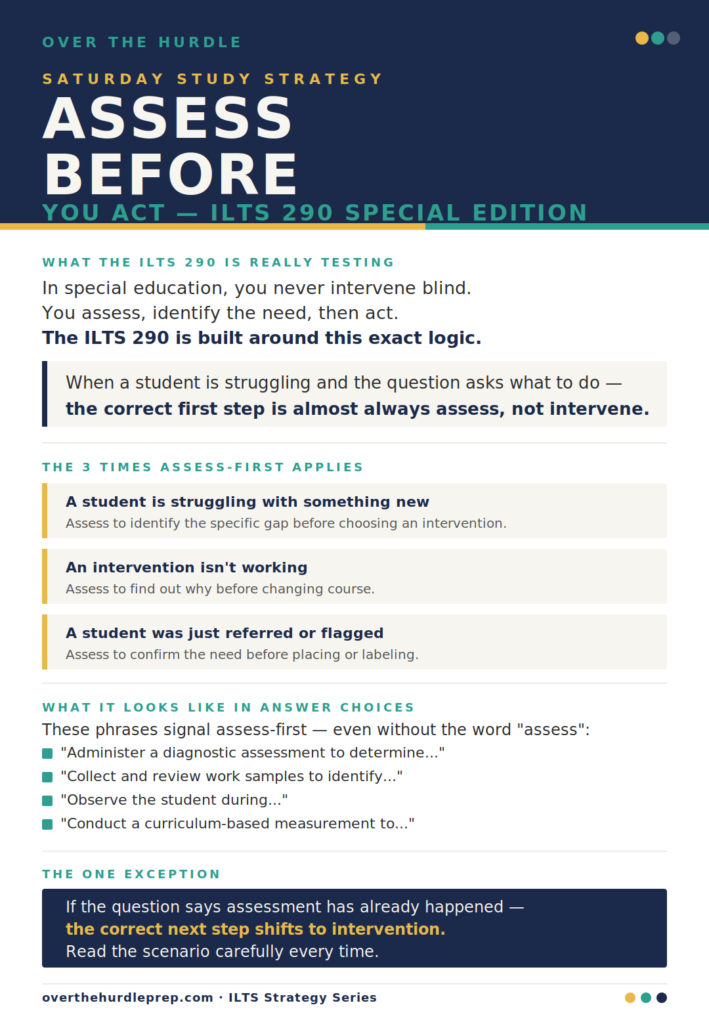
The ILTS 290 wants you to assess before you intervene
In special education, you never intervene blind. You assess, you identify the need, then you act. That order is not a nice-to-have. It is the whole foundation of how special education decisions are supposed to be made, and the ILTS 290 is built around that exact logic.
So when a student is struggling and the question asks what to do first, the correct first step is almost always to assess, not to intervene.
This is not because intervention is wrong. It is because you do not act until you know exactly what you are acting on. Jumping to a strategy before you understand the actual need is the special education equivalent of prescribing before diagnosing. The test knows it. It writes answer choices specifically to see whether you know it too.
Once you see this, you stop reading these questions as “which intervention is best” and start reading them as “where are we in the process.” That single shift changes which answer looks correct.
The 3 times assess-first applies
Save these. The three triggers alone will change how you read these questions, because almost every assess-first scenario falls into one of them.
A student is struggling with something new. When a student hits a wall with new material or a new skill, the correct move is to assess and identify the specific gap before you choose an intervention. You cannot pick the right support until you know what is actually breaking down.
An intervention is not working. When a strategy is already in place and it is not getting results, the answer is not to immediately swap in a different strategy. It is to assess and find out why the current one is failing before you change course. The data tells you what to do next.
A student was just referred or flagged. When a student has been referred, flagged, or is being considered for a placement or label, you assess to confirm the need before placing or labeling. You never move a student based on a hunch or a single observation.
Struggling with something new, an intervention that is not working, or a fresh referral. If you can name which trigger a scenario is pulling, you are most of the way to the answer.
What assess-first looks like in the answer choices
Here is the part that trips people up. The correct answer will not always use the word assess. The test hides assess-first answers inside specific actions, and you have to recognize them on sight.
These phrasings all signal assess-first, even without the word assess:
- “Administer a diagnostic assessment to determine…”
- “Collect and review work samples to identify…”
- “Observe the student during…”
- “Conduct a curriculum-based measurement to…”
Notice what every one of these has in common. They gather information before deciding anything. They end in “to determine,” “to identify,” or “to find out.” When you see an answer choice whose whole purpose is to learn more before acting, that is your assess-first answer wearing a disguise.
Compare that to the tempting wrong answers, which usually jump straight to a fix: provide this strategy, place the student in that group, begin this intervention. Those can be completely valid teaching moves. They are just premature for where the scenario actually is.
The one exception you cannot skip
Assess-first is the default, not a law. There is one situation that flips it.
If the question tells you that assessment has already happened, the correct next step shifts to intervention. The data is already in. Choosing to assess again would be stalling, and the test will punish you for it just as hard as it punishes acting too early.
This is why you read the scenario carefully every single time. One line buried in the stem, something like “after reviewing assessment data” or “based on the results of a recent evaluation,” tells you the assess step is done and you are now choosing the intervention. Miss that line and you will pick the assess-first answer in the one moment it is wrong.
Read for where the scenario sits in the process. Before assessment, you assess. After assessment, you act. The whole question turns on that one detail.
Put it to work
The next time you practice ILTS 290 scenarios, slow down on every “what should the teacher do” question and ask yourself one thing first: has assessment already happened in this scenario, or not? Answer that before you look at the choices. You will watch the right answer get a lot easier to spot.
This is the kind of test logic that almost no ILTS 290 prep actually teaches, because most resources are busy reviewing content you already know. Strategy is the part that moves your score.
If you want more of this, subscribe to the email list here. I send strategy breakdowns like this one straight to your inbox so you can walk into your next attempt reading the ILTS 290 the way it is actually built to be read.
Leave a Reply